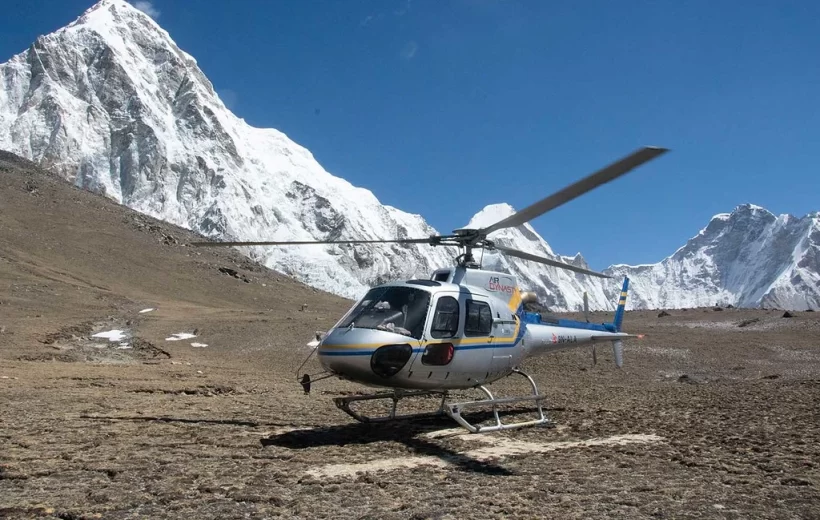
The Everest Base Camp Trek is, without question, one of the greatest walking adventures on Earth. It takes you deep into the heart of the Khumbu Himalaya in northeastern Nepal, through ancient Sherpa villages, sacred Buddhist monasteries, and alpine landscapes that get more jaw-dropping with every step. At the end of it, you stand at 5,364 metres (17,598 ft) - at the foot of the tallest mountain in the world, Mount Everest (8,849 m). That moment is worth every blister.
Nepal Peak Adventure offers a fully-guided, all-inclusive 14-day Everest Base Camp trek package starting from USD 1,360 per person. We take care of every single detail - your domestic flights, permits, accommodation, meals, experienced guide, porter, and emergency support - so you can focus entirely on soaking in the experience.
Whether this is your first big mountain trek or you're a seasoned adventurer adding another pin to your map, this guide gives you everything you need to know before you book.
Everest Base Camp Trek at a Glance
Detail
Information
Trek Duration
14 days (including arrival and departure)
Maximum Altitude
5,545 m / 18,192 ft (Kalapatthar)
EBC Altitude
5,364 m / 17,598 ft
Starting Point
Lukla (2,860 m) after flight from Kathmandu/Ramechhap
Ending Point
Lukla → flight back to Kathmandu
Total Trek Distance
~130 km (65 km one way)
Daily Walking Hours
4–7 hours
Difficulty
Moderate to Strenuous
Best Seasons
Spring (Mar–May), Autumn (Sept–Nov)
Minimum Age
12 years
Group Size
2–20 people (private treks available)
Package Price
From USD 1,360 per person
Accommodation
Hotels in Kathmandu + Teahouses/Lodges on trail
Meals Included
Full board (breakfast, lunch, dinner) throughout
What Is the Everest Base Camp Trek?
The Everest Base Camp trek follows the same approach route used by Everest expedition teams heading to the mountain's south side. You fly into Lukla's Tenzing-Hillary Airport - one of the most thrilling short-haul flights in the world - and then trek northeast through the Khumbu region for about 11 days of walking, with two rest-and-acclimatization days built in along the way.
The route passes through the legendary trade hub of Namche Bazaar, the revered Tengboche Monastery, the high-altitude yak pastures above Dingboche, the eerie glacier moraines near Lobuche, and the last outpost of Gorakshep - before reaching the rocky, flag-strewn plateau of Everest Base Camp itself. The return journey retraces the same route back to Lukla, giving you a second look at landscapes you may have rushed past on the way up.
As a bonus highlight, the itinerary also includes an early-morning hike up Kalapatthar (5,545 m) - the highest point of the trek and arguably the finest viewpoint of Mount Everest anywhere in the world.
Why the Everest Base Camp Trek Belongs on Your Bucket List
Millions of people dream about this trek. But only those who actually do it understand why it changes people. Here is what makes the Everest Base Camp trek so extraordinary:
1. The Mountains Are Simply Breathtaking
You will spend nearly two weeks surrounded by some of the highest peaks on Earth. The views change constantly as you gain elevation. From Namche, you catch your first glimpse of Everest over the ridge. From the Everest View Hotel above Namche, you see Ama Dablam (6,812 m) in all its photogenic glory. From Kalapatthar, you look directly across at the South Face of Everest, the Khumbu Icefall tumbling beneath you, and a full panorama stretching from Pumori to Lhotse and beyond. No photo truly prepares you.
2. The Sherpa Culture is Unforgettable
The Khumbu region is the ancestral homeland of the Sherpa people - the high-altitude mountaineering community whose skill, endurance, and hospitality have made Himalayan exploration possible for over a century. Along the trail, you'll pass through Sherpa villages where Buddhist prayer flags snap in the mountain wind, mani stones carved with sacred mantras line the paths, and ancient gompas (monasteries) cling to rocky hillsides. At Tengboche Monastery, you can witness early-morning prayers and feel the weight of centuries of tradition. This cultural richness is something you simply don't get on most mountain treks in the world.
3. Sagarmatha National Park - A UNESCO World Heritage Site
Shortly after Lukla, the trail enters Sagarmatha National Park, one of Nepal's most important protected areas and a UNESCO World Heritage Site since 1979. The park protects a remarkable array of high-altitude ecosystems - from dense rhododendron and pine forests at lower elevations to barren glacial moraines near the base camp. Along the way, you may spot the red panda, the Himalayan tahr, the elusive snow leopard (though rarely at close range), the yellow-billed chough, and countless other species found nowhere else on Earth.
4. The Personal Achievement is Real
Completing the Everest Base Camp trek is genuinely hard. The altitude alone makes it more challenging than any trekking destination in most countries. Most days require four to seven hours of sustained uphill and downhill walking on uneven, rocky trails. By the time you reach Gorakshep and then the base camp itself, your legs know they've done something significant. Standing there, looking up at the Khumbu Icefall, knowing you walked every step of the way - that feeling is something you carry for the rest of your life.
5. It Is Achievable for Non-Climbers
Despite its reputation, the Everest Base Camp trek does not require mountaineering skills, ropes, crampons, or technical experience of any kind. It is a long-distance hiking trail. If you can walk for five to seven hours a day, have a reasonable baseline of fitness, and prepare yourself mentally for the altitude, you can complete it. Every year, thousands of trekkers from all walks of life - teachers, retirees, students, office workers, fitness beginners - make it to the base camp. You just need to want it badly enough.
Services Included in Everest Base Camp Trek Package:
Our Everest Base Camp Trek package for 14 days includes all the expenses such as permits, accommodations, meals, experienced guides, porters, and necessary transportation throughout the trek to ensure a seamless and rewarding journey to the iconic Everest Base Camp. Here is what is included in the package in detail.
Upon Arrival, Airport Pick-up and transfer to your hotel on a Private Vehicle.
Welcome dinner in a reputed Restaurant with a Live Nepali Cultural Program.
2 Nights Stay at star standard accommodation based on twin sharing in Kathmandu with Bed and breakfast.
Kathmandu to Lukla & Lukla to Kathmandu flight fare (When operated from Kathmandu Airport).
Ramechhap to Lukla & Lukla to Ramechhap Flight fare (When operated from Ramechhap Airport).
Transportation Service for Ramechhap from Kathmandu & Ramechhap to Kathmandu.
All Airport tax and Domestic transfers are provided.
Night Stay at Teahouse/Mountain Lodge accommodation during the trek | 5 nights with attached bathroom service (1-night Phakding, 3 nights Namche, 1 night Lukla) | 6 Nights common room based on twin sharing on other days during the trek.
Free 5 Hot Shower services when staying in tea houses during the trek at Phakding, Namche, and Lukla.
All meals (Breakfast, Lunch, and Dinner) during the trek | Continental, Nepali, Italian, Chinese & Indian
Seasonal fruits during the trek after each dinner
3 cups of coffee/tea every day during the trek on every meal
Cost of Excellent Guide & his entire expenses (government certified experienced, fluent English speaker, first aid and eco trained).
Porter’s cost & his entire expenses (one porter for every two members in a group)
Insurance of Guide & Porter
Daily Oxygen level check through Oximeter
All permit fees (Local rural municipality permit fee/Sagarmatha National Park fee)
All Government and Local body taxes as applicable
Renting Down Jacket and sleeping bags (upon request)
A duffle Bag and a T-shirt (as a souvenir)
Trekking map
Certificate of Trek completion from NPA
Group First Aid Kit Box (first aid kit carried by a guide)
The arrangement of Emergency Helicopter evacuation according to your travel insurance company
Farewell Dinner before your departure day in a reputed restaurant
Final departure transfer
If you want to add other extra services, then you can call us or chat with us online.
Services Not Included in Everest Base Camp Package:
Nepal Visa Fee
Your International flight to Kathmandu and a return ticket from Nepal.
Your meal at Kathmandu besides welcome dinner, farewell dinner, and breakfast
The entire cost of beverages (except hot drinks mentioned in the inclusion list), mineral water and beer, etc. while on the treks
Travel insurance (must include Helicopter evacuation)
Tipping to the guide and porter
Anything not included in the trip inclusion list is your expenses
EBC Trek Package Cost and Group Discounts
Our standard Everest Base Camp trek package costs USD 1,360 per person for individual bookings or groups of up to 4 people. For larger groups, we offer substantial discounts:
Group Size
Price Per Person (USD)
Additional Benefit
1–4 Pax (standard)
USD 1,360
—
5–12 Pax
USD 1,250
—
13–15 Pax
USD 1,200
—
16–20 Pax
USD 1,175
1 group leader free
21+ Pax
USD 1,130
2 group leaders free
Why USD 1,360 is fair value – not just cheap:
Some agencies advertise EBC treks for USD 800–1,000. Look carefully at those packages. They typically exclude porter fees, charge separately for meals above Namche, use under-qualified guides without insurance, and often leave trekkers with surprise costs of USD 300–600 on the trail. Our price is transparent. No surprises. No compromises on safety. No hidden charges. What you see is what you pay.
Everest Base Camp Trek Difficulty – What to Realistically Expect
Let’s be straightforward: the Everest Base Camp trek is moderate to strenuous. It is not a technical climb, but it is also not a casual countryside walk. Here is what makes it demanding – and how to prepare for it.
Altitude
Altitude is the number-one challenge on this trek. As you climb above 3,000 m, the air contains progressively less oxygen. At Kalapatthar (5,545 m), you are breathing roughly half the oxygen available at sea level. Symptoms of Acute Mountain Sickness (AMS) – headaches, nausea, fatigue, dizziness – can affect anyone regardless of fitness level. This is precisely why our 14-day itinerary builds in two full acclimatisation days at Namche Bazaar (3,440 m) and Dingboche (4,410 m). The golden rule of altitude trekking is: climb high, sleep low, and never rush. Our guides monitor your oxygen saturation daily with a pulse oximeter.
Daily Walking
Expect to walk between 10 and 16 km per day, for four to seven hours of active trekking. The trail is never flat for long – you are constantly ascending and descending along rocky, rooty, sometimes narrow paths. There are no paved roads. Suspension bridges wobble. On the steepest days (particularly Phakding to Namche), the trail climbs relentlessly for 800+ metres. Your legs will feel it.
Weather and Cold
Even in the best trekking seasons (spring and autumn), temperatures at high camps can drop well below freezing at night. At Gorakshep and Kalapatthar, night temperatures can reach -10°C to -20°C. Daytime walking is generally comfortable if the sky is clear, but sudden weather changes, cold winds above 4,000 m, and occasional snow are all possible. Proper layering is essential.
Who Can Do This Trek?
Anyone in good general health who does regular exercise can complete this trek with proper preparation. You do not need prior high-altitude experience, but we strongly recommend training for at least 8-12 weeks beforehand. Focus on cardiovascular fitness (running, cycling, swimming), leg strength (squats, lunges, stair climbing), and long-distance walking – ideally with a loaded daypack on hilly terrain.
Best Time for the Everest Base Camp Trek
The Everest Base Camp trek is possible year-round, but some seasons are significantly better than others. Here is a season-by-season breakdown to help you plan your trip:
Spring (March – May) Best Season
Spring is the most popular trekking window, and for good reason. Temperatures are mild, rhododendron forests burst into bloom with red and pink flowers, and the sky offers reliable clarity for mountain views. This is also Everest climbing season, so you may encounter summit expedition teams heading up the valley – adding a dramatic bonus to the experience. Trails are busiest in April and May, so book early and expect company in the teahouses.
Autumn (September – November) Best Season
Post-monsoon autumn delivers fresh, crystal-clear skies and some of the best visibility of the year. The landscape is lush and green from the rains, waterfalls are full, and the air feels washed clean. October is considered by many trekkers to be the single best month of the year for the EBC trek. November gets colder, especially at higher elevations, but the trails thin out and the solitude is wonderful.
Winter (December – February) For Experienced Trekkers
Winter brings brutal cold and occasional heavy snowfall, particularly above 4,000 m. However, the trails are quiet, the skies are often perfectly clear, and the mountain views are spectacular. If you are physically prepared and have the right gear, a winter EBC trek can be an intensely rewarding experience. Some higher tea houses may be closed, and our team will adjust logistics accordingly.
Monsoon (June – August) Not Recommended for Most
The summer monsoon brings heavy rainfall, leeches on the lower trails, frequent cloud cover blocking mountain views, slippery paths, and an elevated risk of landslides. Most experienced trekkers avoid this window. However, if you are specifically interested in the Khumbu’s lush greenery and can handle wet weather, the trails are extremely quiet, and costs are lower. We can organise monsoon treks for those who specifically request them.
Everest Base Camp Trek Distance and Altitude Profile
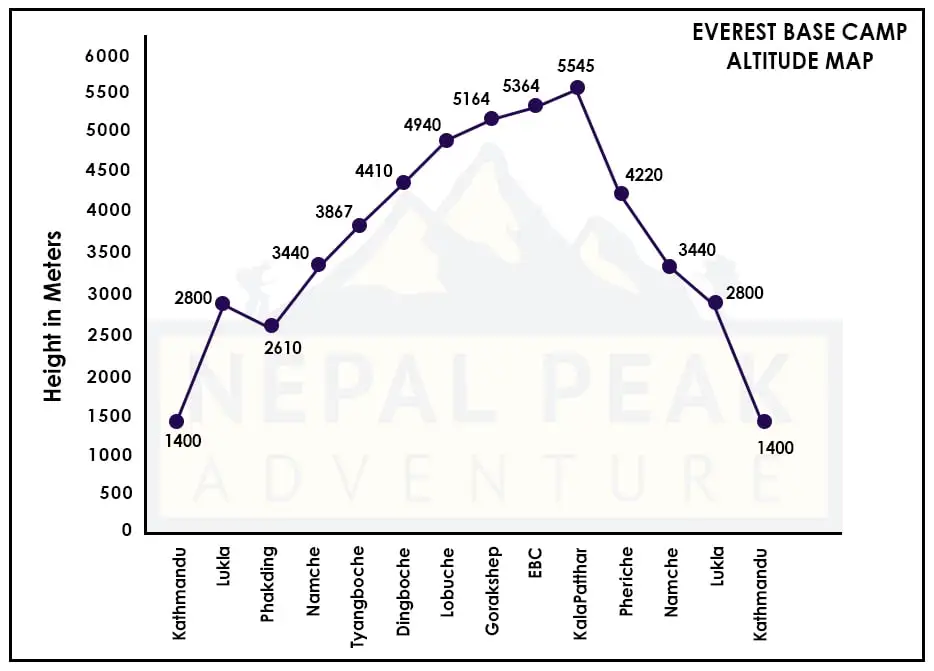
The one-way trekking distance from Lukla to Everest Base Camp is approximately 65 kilometres (40 miles). The round trip totals around 130 km. Here is the full elevation profile across the 11 days of trekking:
Destination
Altitude
Gain/Loss vs Previous
Lukla (start)
2,860 m / 9,383 ft
–
Phakding
2,610 m / 8,563 ft
– 250 m
Namche Bazaar
3,440 m / 11,286 ft
+830 m
Acclimatisation hike (Everest View Hotel)
~3,900 m / 12,795 ft
day hike
Tengboche
3,867 m / 12,687 ft
+427 m
Dingboche
4,410 m / 14,468 ft
+543 m
Acclimatisation hike (Nangkartshang Peak)
~5,000 m / 16,404 ft
day hike
Lobuche
4,910 m / 16,109 ft
+500 m
Gorakshep
5,164 m / 16,942 ft
+254 m
Everest Base Camp
5,364 m / 17,598 ft
+200 m
Kalapatthar (highest point)
5,545 m / 18,192 ft
+381 m
Descent: Pheriche
4,220 m / 13,845 ft
– 1,325 m
Descent: Namche Bazaar
3,440 m / 11,286 ft
– 780 m
Descent: Lukla (end)
2,860 m / 9,383 ft
– 580 m
Everest Base Camp Trek Altitude Chart
Kalapatthar – The Highest and Best Viewpoint on the Trek
Most people think reaching Everest Base Camp is the climax of this trek. But ask anyone who has done it, and many will tell you that the predawn hike to Kalapatthar – the volcanic black rock peak sitting directly across from Everest – delivers the single most powerful moment of the entire journey.
You leave Gorakshep in the dark, headlamp blazing, in temperatures that often sit well below −10°C. The trail climbs steeply for about 90 minutes. And then, just as you reach the ridge, the sun cracks the horizon behind the Himalayan giants and floods the entire sky in crimson and gold. Mount Everest’s summit pyramid glows directly in front of you. Lhotse, Nuptse, Pumori, Ama Dablam, Changtse – they are all there, in a 360-degree panorama you could not have imagined from the trailhead in Lukla nine days earlier. It is, without exaggeration, one of the great sunrise experiences on the planet.
Acclimatisation – Why Our 14-Day Itinerary Gets It Right
The single biggest risk on any high-altitude trek is going too fast. Nepal Peak Adventure has designed this itinerary over years of experience to give your body the best possible chance of adapting safely to the altitude. Here is how our acclimatisation strategy works:
Acclimatisation Day 1 – Namche Bazaar (3,440 m)
After the steep climb from Phakding to Namche, your body needs time to adjust before going higher. On your rest day in Namche, your guide leads you on a morning excursion to the Sherpa Museum and up to the Everest View Hotel – reaching around 3,900 m – before returning to sleep at 3,440 m. This classic “climb high, sleep low” approach triggers your body to produce more red blood cells, improving your capacity to absorb oxygen at higher elevations.
Acclimatisation Day 2 – Dingboche (4,410 m)
By Day 7, you are at 4,410 m – above the altitude where AMS risk increases sharply. Another full rest-and-hike day is built into the schedule here. Your guide leads you on a hike up to Nangkartshang Peak (around 5,000 m), offering magnificent views of Ama Dablam, Makalu, Lhotse, and Everest, before you descend back to sleep in Dingboche. This second acclimatisation day significantly lowers the risk of altitude sickness on the final push to EBC and Kalapatthar.
Pulse Oximeter Monitoring
Every evening at camp, your Nepal Peak Adventure guide will check your blood oxygen saturation with a portable pulse oximeter. Normal values at altitude are typically 80-90% (compared to 95-99% at sea level). If your reading drops too low or you show signs of AMS, your guide will make the call to descend – because no summit, view, or photo is worth risking your health.
Sherpa Culture and the Khumbu Community
Trekking to Everest Base Camp is not just a physical challenge – it is a genuine immersion into one of the most remarkable mountain cultures in the world. The Sherpa people have lived in the Khumbu region for centuries, migrating originally from Tibet. Their intimate knowledge of the mountain terrain, extraordinary physical resilience at altitude, and deep Buddhist spirituality make them unlike any other people you are likely to meet.
As you walk through villages like Phakding, Namche Bazaar, Tengboche, Pangboche, and Dingboche, you will see the evidence of this culture everywhere: prayer flags strung across valleys to carry blessings on the wind, chortens (Buddhist shrines) marking the tops of passes, mani walls built from stones carved with the mantra Om Mani Padme Hum, yaks decorated with coloured tassels carrying loads up the mountain, and monks in crimson robes performing rituals at ancient monasteries.
Nepal Peak Adventure strongly believes in responsible, community-supportive tourism. Our guides are all trained local Sherpas who receive fair wages, insurance coverage, and proper working conditions. By trekking with us, you are directly contributing to the livelihoods of Khumbu families and helping sustain this extraordinary culture for future generations.
Why Choose Nepal Peak Adventure for Your Everest Base Camp Trek?
There are dozens of trekking companies offering the Everest Base Camp trek. So why choose us? Here is what genuinely sets Nepal Peak Adventure apart:
✅ Ranked in the Top 50 of 1,545+ Nepal travel companies on TripAdvisor, with a Travellers’ Choice Award
✅ Zero negative reviews — 100% client satisfaction record
✅ Government-licensed, certified guides — all hold first aid certification and are eco-trained
✅ Ethical treatment of porters — fair wages, insurance, and a strict 10 kg per-trekker weight limit
✅ Daily oxygen monitoring with pulse oximeter — included as standard, not an add-on
✅ Fully transparent pricing — no hidden charges, no surprise add-ons on the trail
✅ Personalised itineraries — we can adjust the route, pace, or add-on extensions to suit your needs
✅ 24/7 support — our team in Kathmandu is always reachable, even mid-trek
✅ Emergency helicopter evacuation assistance coordinated with your travel insurer
✅ Sustainable tourism commitment — we offset our environmental footprint and support local conservation efforts
Everest Base Camp Trek Side Trip Options and Extensions
The Khumbu region has far more to offer than just the Base Camp route. If you have extra time — or simply want to make the most of your journey to Nepal — Nepal Peak Adventure can seamlessly incorporate any of the following extensions into your itinerary:
Gokyo Valley & Gokyo Ri: A stunning alternative leg that takes you past the turquoise Gokyo Lakes and up Gokyo Ri (5,357 m) for a panoramic view of four 8,000-metre peaks at once
Ama Dablam Base Camp: A short side trek off the main EBC trail to the base of one of the world’s most beautiful mountains — a favourite with photographers
Island Peak Climbing (Imja Tse, 6,189 m): A beginner-friendly high-altitude peak climbing experience that can be added after EBC for those who want to go higher still
Lobuche Peak Climbing: A more technically demanding summit option for trekkers with some mountaineering experience
Kathmandu Valley Sightseeing: Add a 1–2 day cultural tour of Kathmandu before or after the trek — visiting Boudhanath Stupa, Pashupatinath Temple, Swayambhunath, and Patan Durbar Square
Contact us with your interests and we’ll build a custom itinerary that fits your timeline and goals.
Day 1 Arrival at Kathmandu (1400m/4,593ft) and transfer to the hotel
Upon your arrival at Tribhuvan Internationa Airport, our team Nepal Peak Adventure will be there to pick you up from the Airport. After your meet-up with our team, you will be escorted to the Thamel area which is the biggest tourist hub.
This day is very crucial because all the incomplete preparations for the trek will be completed today like renting gear, exchanging money, sharing information, and many other things. If enough time, you can go for a short walk to the nearest heritage site Kathmandu Durbar Square. At night, we usually throw a welcome dinner with a typical Nepalese cultural dance. Also, most of the briefing about the trek will also be done during dinner.
Accommodation: Standard Hotel Meals: Dinner
Day 2 Lukla flight from Kathmandu or Ramechhap and Trek to Phakding (2610m/8,563ft) 3-4 hours
As per the flight details, you will be accompanied by our guide from your hotel and will be transferred to the Ramechhap Airport or Kathmandu Airport for the domestic flight to Lukla. The flight will be around 25-30 min to Lukla which will be the most thrilling flight in the world.
After reaching Lukla, you will have your breakfast there as well and you will meet your porters too who will assist you the entire trek. After you are all set to go, your actual trek begins by passing through the marketplace of Lukla and following along the Dudhkoshi River. As you reach the end gate of Lukla you will stop there at the checkpost for all the permits and administrative procedures.
The journey then continues further passing several local settlements as Cheplung, Thadokoshi, and Ghat before reaching the Phakding village. After 3/4 hours of the walk, while enjoying the introductory terrain and the beauty of the Khumbu region, you will arrive at Phakding where you will stay overnight.
Accommodation: Tea House/Lodge Meals: Breakfast/Lunch/Dinner Duration: Approximately 3-4 hours
Day 3 Trek from Phakding to Namche Bazar (3440m/11,286ft) 6 hours
After having breakfast in Phakding, our destination today will be the Namche Bazar which is like the capital city of the Khumbu Region. On this day, you will cross many suspension bridges following the gushing Dudh Koshi River with green vegetation on the bank as most of the trail goes near this river today.
After reaching Monjo, your guide will make the necessary administrative procedures (showing permits and check-in) in order to enter the Sagarmatha National Park. After walking 10 mins away from here you will arrive at Jhorsalle where you will stop for lunch. Please note that there are no stop-place after this place until you reach Namche.
After lunch and resting for a brief, your trek continues to the famous Hillary suspension bridge. Take your time to engage in the photo session and adore the beauty of nature. After crossing the bridge the trail then ascends through a beautiful pine forest before entering a renowned Namche Bazar. As mentioned Namche Bazar is like the capital city of the Khumbu region, it is also the biggest trading hub and has basic facilities such as hotels, restaurants, a money exchange counter, a cafe, a bakery shop, and many other shops. Also, you will have time to explore the Bazar and you be staying here for an overnight.
Accommodation: Tea House/Lodge Meals: Breakfast/Lunch/Dinner Duration: Approximately 5-6 hours
Day 4 Acclimatization day at Namche Bazar | Hike to Syangboche and Everest Viewpoint
Acclimatization is very important when trekking to high altitudes because it lets your body to adjust the atmosphere. It is like preparing for the upcoming higher elevation so that you won't get AMS.
So, after breakfast in your lodge, your guide will take you for a day excursion including to the Sherpa museum. Sherpa Museum is the oldest museum that displays the artworks that depict the Sherpa way of life. Also, the open space near the park gives you a great view of the Himalayan range. After the quick visit, you will go to Tenzing Park where you can see the statue of the legendary mountaineer Tenzing Norgay Sherpa (the first man to climb Everest with Sir Edmund Hillary).
Afterward, you will go up a steep trail to the Everest View Hotel; from where you will be rewarded with better views of Mt. Everest, Nuptse, Amadablam, and many others with a delightful tea break. After all the day activities are done you’ll head back down to the Namche and can rest or explore the town. Overnight at Namche Bazar.
Some of the mountains on view today are Kwangde (6,011m), Thamserku (6,623m), Kangtega (6,782m), Nuptse (7,861m), Lhotse (8,516m), Ama Dablam (6,812m) and, of course, Mount Everest (8,848m).
After breakfast, you will head to our next destination-Tengboche which is a 4-5 hour walk. After a short walk, a quick ascend will continue on a moderate flat surface trail till Sanasa. From here the trail descends down about an hour through pine woods till you reach Phunki Thanga where you will stop for lunch. You will enjoy splendid views of Khumbu mountain ranges along the route.
After having your Lunch at Phunki Thanga you will then ascend to Tengboche through a sub-tropical forest. It takes about 2 hours to climb that steep uphill part. Upon reaching the Tengboche, is the biggest and one of the oldest monasteries in the Khumbu region with fluttering Buddhist flags. You can enter the monastery by getting the permit which costs NRS 300. Towering Ama Dablam in the background of the Monastery looks superb. Overnight stay at Tengboche.
Accommodation: Tea House/Lodge Meals: Breakfast/Lunch/Dinner Duration: Approximately 4-5 hours
Day 6 Trek to Dingboche (4410m/14,468ft) 6 hours
With a sound of morning prayer and a breakfast in Tengboche, your journey will continue to Dingboche which is at 4,410m elevation. Following a quick descent, the trail continues through a forest passing the settlements like Deboche and Millinjo until you cross a stream and the suspension bridge. Thereafter, you will enter the stony barren land and one of the major settlements Pangboche. You can stop here for the short tea break or keep continue the trek.
An hour later from this village you will reach Somare for lunch. After a delightful lunch and a quick rest, you will be all good to go to Dingboche, where you will spend your night.
Accommodation: Tea House/Lodge Meals: Breakfast/Lunch/Dinner Duration: Approximately 5-6 hours
Day 7 Acclimatization day at Dingboche | Hiking to Nangkartshang Peak
You are now at 4,410m altitude therefore you will need to acclimatize in Dingboche to stay safe from AMS. To prepare well for AMS, today you will hike to Nangkartshang Hill which is above 5,000m/16,404ft above. Along the hike, you will be rewarded with a spectacular view of the Ama Dablam, Kangtega, Taboche, Cholaste, Nuptse, Everest, and Makalu among many others. It will take around three hours on average to reach the top. Make sure you are walking slowly.
In the afternoon, don't forget to visit a local bakery to watch a movie/documentary related to the mountains while enjoying bakery items. Also, you can roam around the village to learn more about the local people and traditions. Dingboche is also one of the major hubs and big settlements in the Everest region.
Enjoy your dinner and have a good night's rest. Overnight stay.
After getting ready for the next challenge, you will depart from Dingboche following your breakfast early in the morning. It is a quick ascend for a while and the trail goes through a flat terrain till Thukla. Along the way, you can enjoy the spectacular views of Mount Taboche and Cholaste. You will stop for refreshment or lunch at Thukla to prepare you for the short rocky uphill up to Thukla Pass. It is an hour steep uphill climb on the rugged trails to the Thukla or Everest Memorial. The memorial is all about the monuments built for the late climbers who lost their lives in the mountains. We will pay tribute to the deceased souls and continue our trek.
After about an hour of walking over a rocky trail, you will arrive in Lobuche where you halt for the day.
Accommodation: Tea House/Lodge Meals: Breakfast/Lunch/Dinner Duration: Approximately 5-6 hours
Day 9 Trek to Everest Base Camp (5364m/17,598ft) via Gorekshep and trek back to Gorekshep (5164m/16,942ft) 7 hours
This is the major and exciting day of the entire trip as you will reach the Everest Base Camp today. After the breakfast, you will resume your treks. The first part of the trail from Lobuche is on a flat surface till Lobuche pass. It takes around one hour to reach that part. Upon reaching and crossing the Lobuche pass, the trail gets a bit tricky and difficult as the trail winds through the rugged path and glaciers with a frequent passing of animals (yaks, horses, jockeys) along the way. Some parts of the trail are quite narrow and have to be extra careful. After two hours you will arrive at the last settlement Gorakshep where you will spend the night.
Upon reaching Gorakshep, you will have lunch and get ready for the hike to the Everest Base Camp which will take around two hours approx.
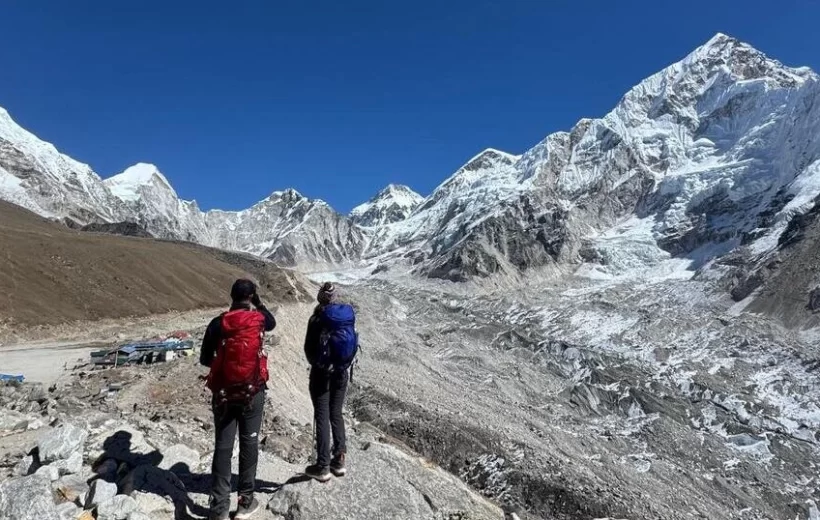
Finally, the moment is here. Now your lifetime dream come true, you will be there at the base camp of the world’s highest mountain. Express your victory, take photos, and videos because you have made the memories to be cherished forever. After spending some time on the base camp you will return back to Gorakshep for the overnight stay.
Accommodation: Tea House/Lodge Meals: Breakfast/Lunch/Dinner Duration: Approximately 5-6 hours
Day 10 Hike to Kalapatthar (5545m/18,192ft) and trek back to Pheriche (4220m/13,845ft) 7 hours
Yet today is another big day. You have to wake up early morning at around 4 o’clock to witness the mesmerizing sunrise view over the top of the world Mt. Everest from Kalapatthar. The hike is definitely going to a tough one but worthwhile.
Kalapatthar, one of the highest vantage points in the world offers you a marvelous feat of Mount Everest and a wide range of mountains in the region. The bright crimson color of the rising sun adds beauty to the Mountain range. Return back down and enjoy the hearty breakfast before heading to our today’s destination Pheriche.
Accommodation: Tea House/Lodge Meals: Breakfast/Lunch/Dinner Duration: Approximately 6-7 hours
Day 11 Trek to Namche Bazar (3440m) 7 hours
After breakfast at Periche, the trail leads you down through mountain shrubs where you can have a click of the yaks in the pasture. You will cross a couple of settlements like Pangboche, and Tengboche while enjoying the juniper and rhododendron wood. You should be happy to be back at Namche Bazaar at a moderate pace to enjoy the lively evening there.
In the evening you can just relax and enjoy at the bakeries, bars or pubs. You deserve it.
Accommodation: Tea House/Lodge Meals: Breakfast/Lunch/Dinner Duration: Approximately 6-7 hours
Day 12 Trek to Lukla (2860m/9,384ft) 7 hours
This is the last day of the trek. You will climb down the hills from Namche and continue the trail along the Dudhkoshi River to Lukla. You will continue walking devouring the beauty of the area that you missed while ascending. After freshening up and packing your luggage; you can explore Lukla to know a bit little about local people and their culture.
Accommodation: Tea House/Lodge Meals: Breakfast/Lunch/Dinner Duration: Approximately 6-7 hours
Day 13 Fly back to Kathmandu (1400m)
You will get ready with your backpacks and reach the nearby Lukla airport to take a flight back to Kathmandu. You will enjoy green hills, and dense forests and have a chance to catch a glimpse topography of the hilly area while on board.
You will be transferred to the hotel from Kathmandu airport. You can have some time for exploring Kathmandu valley and buying souvenirs today. You will have a farewell dinner with the company’s representative.
Accommodation: Standard Hotel Meals: Breakfast/Lunch Duration: 30 min flight
Day 14 Departure from Kathmandu (1400m)
This is the final day in Nepal for this time. Our representative will transfer you to the Tribhuvan International Airport from the hotel as per your flight schedule. You will fly back to your sweet home with beautiful memories of Nepal.
Packing List for the Everest Base Camp Trek
Preparing for Everest Base Camp Trek is the most important thing and when it comes to packing gears, you need to be extra careful to choose the right material and the right gears only. Good preparation and well-thought-out packing contribute to the successful trek.
We do the brief packing list checkup at Kathmandu during the briefing session and also provide you with the company duffel bag. Please note that there is a weight limit of 20 kg of luggage carried by our porter and one porter is assigned for two trekkers. So, per trekker luggage weight is 10 kg at max. Hence, we would like to request you to pack accordingly.
From headwear to footwear, here is the list of gear you will need to complete the Everest Base Camp Trek properly.
Basic Gears and Equipment
Duffle Bag (The company will provide you 50-70 liters duffle bag)
Day Pack (35-45 liters recommended) with rain cover
Trekking Poles (1 pair)
Four-season sleeping bag (can be rented at Thamel)
Sleeping bag liner (optional)
Personal first aid kit and meditations (Our guides will carry a first aid kit provided by the company however you can have your own with the consultation of your doctor)
Water bottle / Water bladder
Headwear
Beanie (1 Nos)
Sun hat or Cap (we provide free company cap) (1 Nos)
Polarized Sunglass (1 Nos)
Buff/Neck Gaiter (1 Nos)
Headlight (1 Nos)
Body Wear
Insulating layers/thermal wear (2 pair)
T-shirt (2 pairs)
Full sleeve t-shirt (thin and thick) (1 each)
Waterproof and windproof outer layers (1 Nos)
Fleece jacket (1 Nos)
Down jacket (Company provides)
Lower Body:
Hiking Pants (2 pair)
Comfortable pants for the teahouses (1 Nos)
Hiking shorts (optional)
Waterproof and windproof pants (optional)
Hand Wears:
Fabric liner gloves (1 pair)
Hard-shell outer glove (1 pair)
Feet Wears:
Fabric warm socks (2/3 pair)
Hiking socks (2/3 pair)
Trekking boot high ankle with good grip recommended (1 pair)
Casual shoes for the teahouses
Gaiters (optional)
Personal Utilities
Undergarments (according to your needs)
Pajamas or sleeping clothes (optional)
Sunscreen cream
Toothbrush and toothpaste
Toiletries
Snacks (chocolates, dry fruits, energy bars, etc)
Playing cards
Power banks
Documentation:
Valid passport and necessary permits
Nepal visa
Extra passport-sized photos
Travel insurance details
Emergency contact information
Money (local currency and small denominations)
Note: Most of the gear can be rented in Thamel, Nepal so you don’t need to carry heavy luggage. Also, some of the gear will be provided to you from Nepal Peak Adventure.
Frequently Asked Questions About the Everest Base Camp Trek
How many days does it take to reach Everest Base Camp?
From the moment you land in Lukla, it takes 8 trekking days to reach Everest Base Camp, including two acclimatisation days at Namche Bazaar and Dingboche. The full 14-day package includes your arrival/departure day in Kathmandu and the flights to and from Lukla.
How fit do I need to be for the Everest Base Camp trek?
You need a solid baseline of cardiovascular fitness and the ability to walk for 4–7 hours a day on uneven terrain. You do not need to be an athlete. Start training 2–3 months before your trek: regular long hikes, stair climbing, running, or cycling will prepare you well. Mental resilience and a patient, unhurried attitude are equally important.
Do I need prior high-altitude experience?
No prior high-altitude experience is required. However, if you have never been above 3,000 m before, we recommend acknowledging that you simply do not know how your body will respond to altitude. Most people do fine with proper acclimatisation. Our guides are trained to recognise and manage altitude sickness, and we have clear protocols in place for every scenario.
What is Acute Mountain Sickness (AMS) and how do I prevent it?
AMS is caused by the reduced oxygen levels at altitude. Symptoms include headaches, nausea, fatigue, loss of appetite, and disturbed sleep. The best prevention is ascending slowly, staying well-hydrated (3–4 litres of water per day), avoiding alcohol in the first few days, not over-exerting yourself, and never going higher if you feel unwell. Many doctors also recommend Diamox (acetazolamide) as a preventative medication — consult your GP before the trek. Our guides monitor your blood oxygen levels daily and will make conservative decisions if needed.
Can I do the EBC trek solo?
Legally, all trekkers in the Khumbu region must be accompanied by a licensed guide (regulation introduced by the Nepal Government). Even if you are an experienced trekker, attempting the EBC route without a guide is no longer permitted and is not covered by most travel insurance policies. Our guides add immense value beyond mere compliance — they know the trail, the culture, the weather patterns, and the medical protocols.
Is travel insurance mandatory for the Everest Base Camp trek?
Yes, absolutely. Travel insurance that specifically covers helicopter rescue above 5,000 m is non-negotiable for this trek. A helicopter evacuation from high altitude can cost USD 3,000–6,000 or more. Standard travel insurance often does NOT cover this — check your policy specifically for high-altitude helicopter evacuation before you depart. Nepal Peak Adventure will assist with coordinating emergency evacuation if needed, but the cost must be covered by your insurance.
What Nepal visa do I need?
Most nationalities can obtain a tourist visa on arrival at Tribhuvan International Airport in Kathmandu. The standard tourist visa costs USD 50 for 30 days, which is more than enough for a 14-day EBC package with some days in Kathmandu. You can also apply for a Nepal e-visa online before your departure. Carry extra passport photos and the visa fee in USD or other major currency. Check the Department of Immigration Nepal’s official website for the most current requirements for your nationality.
What is the Ramechhap airport situation during peak seasons?
During the peak trekking seasons (March–May and October–November), heavy air traffic in Kathmandu means Lukla flights are operated from Manthali Airport in Ramechhap, approximately 130 km from Kathmandu. This requires an early-morning departure from Kathmandu (around 12:30–1:00 AM) for a 4–5 hour road transfer to Ramechhap. Nepal Peak Adventure manages this entire transfer as part of your package at no extra charge. The Ramechhap–Lukla flight takes approximately 15 minutes. During off-peak months, flights operate directly from Kathmandu.
Can I skip the trek down and take a helicopter back to Kathmandu?
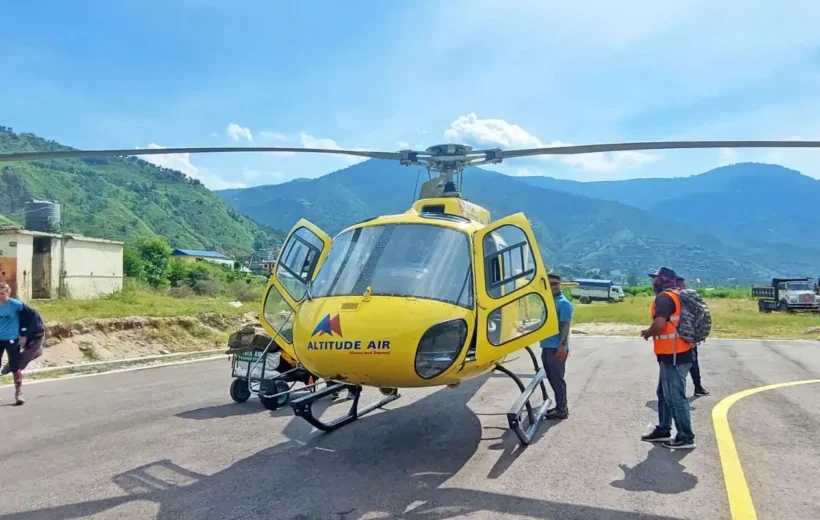
Yes. If you prefer not to trek back down to Lukla, you can arrange a helicopter flight from Gorakshep directly back to Kathmandu. The cost is approximately USD 380 per person on a shared basis (5-person minimum). Let us know in advance and we’ll coordinate the booking and logistics for you.
How many people will be in my trekking group?
Our standard group packages accommodate up to 20 trekkers, with a minimum of 2. We also offer private customised treks for individuals, couples, and families at adjusted pricing. If you are joining a shared group, you will be matched with other travellers with a similar start date. Contact us to check current group departures.
What happens if I get sick on the trail and need to turn back?
Your safety is our top priority — always. If you develop serious AMS symptoms or any other medical issue that requires descent, your guide will accompany you to a lower altitude immediately. For critical cases, our team will coordinate helicopter evacuation through your travel insurer. We have communication equipment on the trail and a 24/7 support team in Kathmandu. You will never be left alone.
How to Book the Everest Base Camp Trek
Booking your Everest Base Camp trek with Nepal Peak Adventure is straightforward:
Reach out to us — via our website contact form, WhatsApp (+977 9841319155), or email. Tell us your preferred dates and group size.
Confirm availability and itinerary — we’ll confirm your dates, discuss any customisations, and send you a full trip dossier.
Pay the deposit — a deposit of 20–30% of the total package cost confirms your booking. We accept secure online payment via our website gateway, bank transfer, and major credit cards.
Send a passport copy — required to book your domestic Lukla flight tickets.
Receive pre-departure info — we’ll send you a comprehensive pre-departure pack covering packing, fitness preparation, visa, travel insurance, and what to expect on arrival.
Pay the balance — the remaining balance is due 30 days before departure, or upon arrival in Kathmandu.
We recommend booking at least 4–8 weeks in advance, particularly for peak-season departures in April–May and October–November, when Lukla flight seats and teahouse rooms fill up fast.
Accommodation on the Everest Base Camp Trek
Understanding what accommodation on the trail actually looks like helps set realistic expectations — and helps you appreciate the moments of unexpected comfort in the mountains.
In Kathmandu
Your two nights in Kathmandu are spent in a star-category hotel in the Thamel district — the lively heart of tourist Kathmandu, full of restaurants, gear shops, money changers, and easy access to pre-trek shopping. Rooms are comfortable, en-suite, and include breakfast. WiFi is reliable. This is your last taste of real hotel comfort before two weeks in the mountains.
On the Trek — Teahouses and Lodges
Teahouses (also called lodges or guesthouses) are the backbone of trekking in Nepal. These family-run mountain guesthouses range from surprisingly comfortable (in the lower villages and Namche) to very basic (above 4,500 m). Here is what to expect:
Rooms: Generally simple twin-sharing rooms with two single beds, a thin mattress, pillow, and blanket. Bring your own sleeping bag for warmth, especially above Namche.
Attached bathrooms (Phakding, Namche, Lukla): Clean en-suite bathrooms with flush toilets and hot showers included in your package.
Shared bathrooms (higher camps): Common toilets (squat or Western) and cold or coin-operated hot shower facilities. Above Dingboche, facilities are more basic.
Common dining room: The social heart of every teahouse — a warm, yak-dung-heated room where trekkers gather for meals, card games, and evening conversation. This is where friendships are made on the trail.
Heating: Most teahouses above 4,000 m rely on solar energy or yak dung. Rooms are typically unheated — the dining room is the warm gathering point.
Electricity: Available and free up to Namche. Above Namche, solar-powered charging is available but charged per device (expect NPR 200–500 per charge).
Food and Meals on the Everest Base Camp Trek
One of the most common concerns first-time trekkers have is food quality at altitude. Here is the good news: Khumbu teahouses serve an impressively varied menu, and your body will likely be craving calories, so everything tastes good.
All meals are included in your package from Day 2 (Lukla) through Day 12 (Lukla). Typical choices include:
Breakfast: Porridge, pancakes, eggs (boiled, fried, scrambled, omelette), toast, muesli, Tibetan bread with jam and butter, and always tea or coffee
Lunch: Noodle soup, pasta, fried rice, Dal Bhat (lentil soup, rice, vegetables, pickles), momo (Nepali dumplings), sandwiches, and hot drinks
Dinner: Dal Bhat, pasta, pizza, Sherpa stew, soup, fried noodles, and seasonal fruit after dinner every evening
Our strong recommendation: Order Dal Bhat whenever possible. It is the traditional Nepali staple meal, it provides sustained energy for the trail, and most teahouses offer a free second serving. It also happens to be delicious.
Note: Above 4,000 m, we advise against eating raw salads, unpeeled fruit, and non-vegetarian meat dishes (which may not have been stored properly at altitude). Stick to vegetarian and well-cooked options to avoid gastrointestinal issues, which are unfortunately common on high-altitude treks.
Drinking Water on the Trek
Staying hydrated is one of the most important things you can do to prevent altitude sickness. Aim for 3–4 litres of water per day. Here are your options on the trail:
Tap water: Available along the trail but must be purified before drinking. Use water purification tablets (chlorine or iodine) or a portable filter/UV purifier (recommended). Bring both as a backup.
Boiled/hot water: Available at teahouses for a small charge (NPR 50–100 per litre). A good option in cold weather.
Bottled water: Available everywhere, but increasingly expensive and less eco-friendly as you go higher (NPR 100–500 per bottle above Namche). Avoid single-use plastic — bring a reusable bottle and purification tablets.
Avoid alcohol for the first few days at altitude — it dehydrates you and impairs your body’s acclimatisation response.
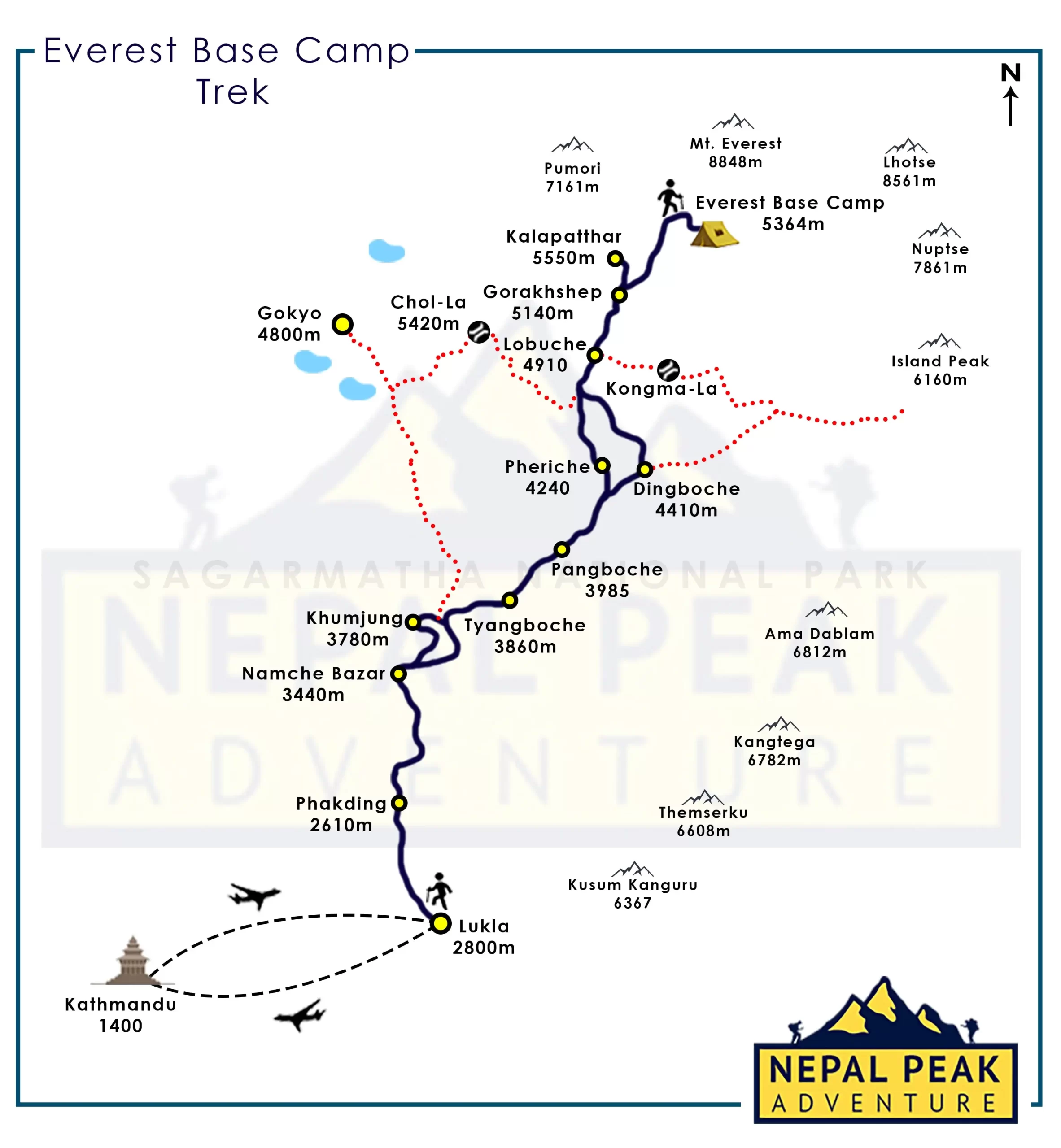
Everest Base Camp Trek Map and Route Guide
Understanding the geography of the Everest Base Camp trek route helps you visualise the journey and track your progress on the trail. Below is a comprehensive description of the route, key landmarks, and navigation information.
📍 Map image note: Insert your existing EBC route map here (alt text: “Everest Base Camp Trek route map showing trail from Lukla to EBC via Namche Bazaar, Tengboche, Dingboche, Lobuche, and Gorakshep”). A downloadable PDF version of the map can be offered via a link.
Geographic Overview
The Everest Base Camp trek is located in the Khumbu region of northeastern Nepal, in Solukhumbu District, within the Sagarmatha Zone. The trek operates entirely within the boundaries of Sagarmatha National Park (and its buffer zone), which covers 1,148 sq km and was established in 1976.
The region is bounded to the north by the Tibetan border, to the west by the Bhote Koshi valley, and is drained primarily by the Dudh Koshi River system — a vast glacially-fed network that collects meltwater from some of the world’s highest peaks before flowing south into the Solu Khumbu hills and eventually into the Ganges system.
The Trekking Route — Stage by Stage
Stage 1: Lukla to Namche Bazaar (Days 2–3)
The trail begins at Lukla (2,860 m) and follows the Dudh Koshi River upstream in a generally northeasterly direction. The river valley is deep and forested at this stage — rhododendron, oak, and pine creating a green corridor between high ridges. You cross the river multiple times on suspension bridges before the steep final climb to Namche Bazaar (3,440 m), which sits in a natural bowl carved into the south-facing slope of the Namche ridge, overlooking the confluence of the Bhote Koshi and Dudh Koshi rivers.
Stage 2: Namche to Tengboche (Days 4–5)
From Namche, the trail climbs to the Namche ridge and traverses eastward to Sanasa before descending steeply to the river crossing at Phunki Thanga. The valley here changes character — the forest becomes denser and more mossy, and the peaks ahead begin to dominate the skyline in a way they don’t from Namche. Tengboche (3,867 m) sits on a prominent ridge with a commanding 270-degree view of the surrounding Khumbu giants.
Stage 3: Tengboche to Dingboche (Day 6)
The trail descends from Tengboche into the Imja Khola valley, then climbs through Pangboche before turning northeast up the Imja Khola towards the wide, elevated basin where Dingboche (4,410 m) sits. The trail from Pangboche to Dingboche follows the true left bank of the Imja Khola through progressively more barren terrain as altitude increases.
Stage 4: Dingboche to Lobuche (Day 8)
This stage leaves the Imja Khola valley and turns northwest up the Khumbu Khola. At Dughla (4,620 m), the trail climbs steeply to the terminal moraine of the Khumbu Glacier — the Thukla Pass — and then traverses north above the glacier to Lobuche (4,910 m). From Lobuche, the enormous Khumbu Glacier — the world’s highest glacier, over 17 km long — is clearly visible to the east.
Stage 5: Lobuche to EBC via Gorakshep (Day 9)
The trail from Lobuche traverses across the lateral moraine of the Khumbu Glacier and reaches Gorakshep (5,164 m) — the last teahouse settlement, occupying a flat sandy lakebed formed from dried glacial runoff. From Gorakshep, the trail to EBC follows the western edge of the Khumbu Glacier northwards for approximately 3.5 km, winding between ice pinnacles and boulder fields to the rocky plateau of Everest Base Camp (5,364 m).
Stage 6: Kalapatthar Viewpoint (Day 10)
Kalapatthar (5,545 m) is a prominent volcanic black rock peak on the southwest ridge of Pumori, rising immediately above Gorakshep to the northwest. The trail from Gorakshep to Kalapatthar climbs the steep scree and rock slope on Pumori’s lower flank. The true summit of Kalapatthar at 5,545 m offers the finest unobstructed close-up view of Mount Everest’s South Face available to non-climbers anywhere in the world.
Key Landmarks and Points of Interest Along the Route
Landmark
Location
Why It Matters
Tenzing-Hillary Airport, Lukla
2,860 m
Start/end of the trek; one of the world’s most dramatic airports
Hillary Suspension Bridge
~2,800 m
Iconic bridge crossing; entrance to Sagarmatha National Park zone
Sagarmatha National Park Gate, Monjo
2,840 m
Permit checkpoint; UNESCO World Heritage Site entry
Khumbu cultural history; panoramic viewpoint of Everest
Everest View Hotel
3,880 m
World-famous high-altitude viewpoint; tea with an Everest backdrop
Tengboche Monastery
3,867 m
Khumbu’s most sacred gompa; Ama Dablam backdrop
Pangboche Village and Monastery
3,985 m
Oldest monastery in Khumbu; Ama Dablam base camp approach starts here
Dingboche
4,410 m
Second acclimatisation hub; high-walled barley terraces
Nangkartshang Hill
~5,000 m
Acclimatisation hike with panoramic 8,000 m+ mountain views
Thukla Pass / Everest Memorial
~4,830 m
Memorial cairns for mountaineers lost on Everest
Khumbu Glacier
4,900–5,400 m
World’s highest glacier; routes to and from EBC cross its lateral moraine
Gorakshep
5,164 m
Last habitation before EBC; base for the final push
Everest Base Camp
5,364 m
The goal — foot of the Khumbu Icefall; world’s most famous base camp
Kalapatthar
5,545 m
Trek’s highest point; unmatched sunrise view of Everest’s South Face
Peaks Visible from the EBC Trek Route
Mountain
Height
Best Viewpoint
Mount Everest (Sagarmatha)
8,849 m
Kalapatthar, Everest View Hotel, Gorakshep
Lhotse
8,516 m
Kalapatthar, Dingboche, EBC
Cho Oyu
8,201 m
Kalapatthar, Gokyo area
Makalu
8,485 m
Nangkartshang Hill, Dingboche
Nuptse
7,861 m
Kalapatthar, EBC, Namche
Pumori
7,161 m
Kalapatthar (Kalapatthar is on Pumori’s ridge)
Ama Dablam
6,812 m
Almost the entire trail from Namche onward — arguably the most photogenic mountain in the Khumbu
Thamserku
6,623 m
Namche, Sanasa ridge
Kangtega
6,782 m
Namche, Tengboche
Kwangde
6,011 m
Namche Bazaar ridge
Taboche
6,367 m
Dingboche, Nangkartshang
Cholatse
6,440 m
Dingboche, Lobuche
Island Peak (Imja Tse)
6,189 m
Dingboche, Chhukung
Required Permits — Where They Are Checked
Two permits are required to complete the Everest Base Camp trek, and they are checked at several points along the route:
1. Sagarmatha National Park Permit
Issued by the Department of National Parks and Wildlife Conservation. Cost: NPR 3,000 (approximately USD 22–25) for SAARC nationals; NPR 3,000 for general foreigners (prices subject to revision — your NPA package covers this). Checked at the park gate in Monjo, near Jorsalle (Day 3). Your guide handles this entirely.
2. Khumbu Rural Municipality Permit (Trek Card)
A local government permit introduced to ensure trekker registration and local government revenue. Checked at multiple points, including the Sagarmatha National Park gate and local checkpoints along the trail. Your NPA package covers this cost entirely.
Both permits are included in your Nepal Peak Adventure package. You do not need to arrange these separately.
Offline Map and Navigation Apps
For trekkers who want to track their location and progress on the trail, we recommend the following offline mapping applications (download the relevant map area in Kathmandu before you leave, while you have reliable WiFi):
Maps.me — free, offline-capable, has the full Khumbu trail network
Gaia GPS — more detailed topographic mapping; popular with serious trekkers
OsmAnd — open-source alternative with excellent offline functionality
That said, with a Nepal Peak Adventure guide by your side, navigation is never a concern. The trail is well-marked and busy during peak season. The maps are for your personal satisfaction and reference.
Internet and Connectivity on the Trail
Staying connected is possible along most of the EBC trail:
Ncell data SIM: Purchase at Kathmandu airport on arrival (tourist packs available). Provides 4G data in Lukla, Phakding, and Namche; connectivity becomes patchy above Namche but signals can often be found at high points
Teahouse WiFi: Available at most lodges throughout the trek. Costs NPR 300–500 per device per session (some offer 24-hour packages). Connection quality varies — fast at Namche, slow and intermittent above 4,500 m
Airlink WiFi cards: Available at Tengboche/Deboche, Dingboche, and Lobuche. Unlimited internet packages cost NPR 700 for 24 hours or NPR 1,200 for 48 hours (one device only)
Above 4,500 m: Expect intermittent connectivity. Load up messages and emails in Dingboche and don’t count on reliable comms above there. It’s actually quite liberating.
Ready to Trek to Everest Base Camp? Here’s How to Start
The Everest Base Camp trek is one of those life experiences that sounds distant and impossible until you book it — and then, before you know it, you are standing at 5,364 metres, staring up at the world’s highest mountain, wondering why you waited so long.
Nepal Peak Adventure has been guiding trekkers to Everest Base Camp for years, with a track record of zero client complaints, 100% summit completion on client-capable days, and the kind of personal service that turns first-time trekkers into lifetime customers who come back for Manaslu, Annapurna, and beyond.
Your 14-day, all-inclusive Everest Base Camp trek starts from USD 1,360 per person. Contact us today to check dates, customise your itinerary, or just ask questions — we love talking mountains.