Nims Dai Quotes: 12 Inspirational Quotes by Nirmal Purja
Nirmal “Nims Dai” Purja was more than a record-breaking mountaineer. He became a symbol of determination, courage, resilience, and the belief that limits are often meant to be challenged.
From the world’s highest mountains to the pages of his own story, Nims Dai repeatedly demonstrated a mindset built around one simple principle: do not accept impossible too easily.
His historic Project Possible expedition, during which he climbed all 14 of the world’s 8,000-meter peaks in just 6 months and 6 days, transformed him into one of the most recognizable figures in modern mountaineering. His journey was later shared with a worldwide audience through 14 Peaks: Nothing Is Impossible.
But perhaps Nims Dai’s greatest influence comes from the words he left behind.
His quotes speak about fear, pressure, failure, ambition, self-belief, mountains, and the importance of continuing when things become difficult.
Following his death in the Broad Peak avalanche in July 2026, his words have taken on an even deeper meaning.
Here are some of the most powerful Nims Dai quotes to inspire anyone facing a mountain of their own.
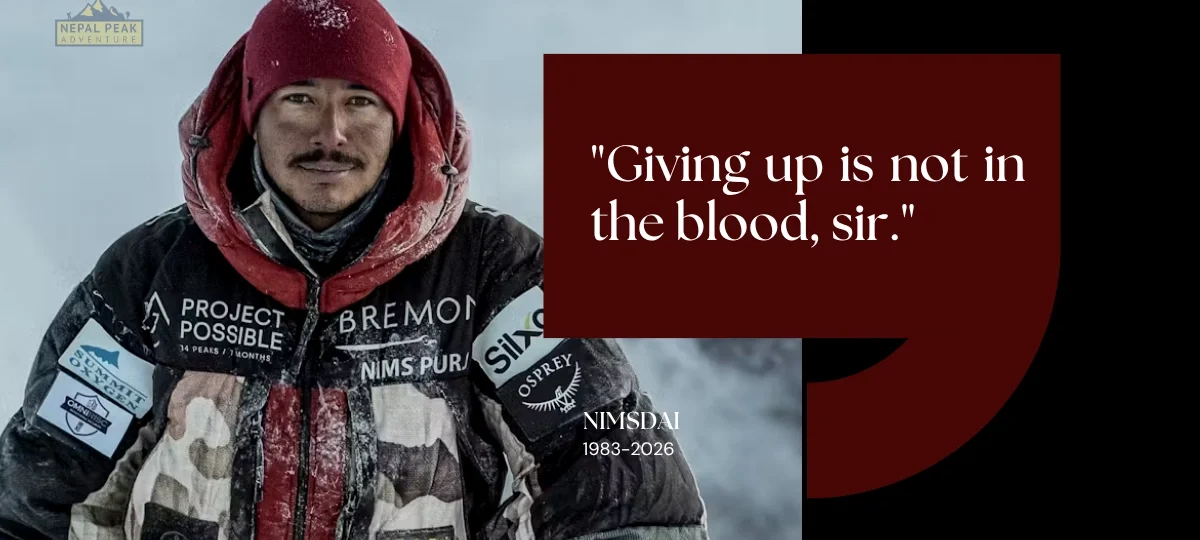
1. “Giving up is not in the blood, sir.”
Few words are more closely associated with Nims Dai than these.
The quote captures the attitude that became a defining part of his mountaineering career. When conditions became dangerous, exhaustion took over, or an objective appeared beyond reach, giving up was never his first response.
For Nims Dai, perseverance was not about pretending that challenges did not exist. It was about refusing to let challenges make the decision for him.
This is a powerful lesson far beyond mountaineering.
Sometimes, success begins with one simple decision:
Keep going.
2. “When you think you’re fcked, you’re only about 45% fcked.”
This is one of Nims Dai’s more humorous—and brutally honest—ways of describing extreme situations.
Mountaineering at 8,000 meters is rarely comfortable. Climbers deal with exhaustion, freezing temperatures, altitude, unpredictable weather, difficult terrain, and the constant awareness that mistakes can have serious consequences.
The quote reflects a mindset of perspective.
When everything seems to be going wrong, it may not actually be as hopeless as it feels.
There may still be options.
There may still be a way forward.
And sometimes, a little humor is exactly what a person needs when facing an overwhelming situation.
3. “The mountain doesn’t care who you are.”
A mountain does not care about your fame, wealth, nationality, experience, or reputation.
It simply exists.
That is one of the reasons mountaineering can be such a humbling experience.
On a high mountain, titles and achievements mean very little. Nature sets the rules, and every climber has to respect them.
The quote also carries a lesson about equality.
The mountain treats everyone according to the same rules.
Whether you are an experienced professional climber or someone standing on a Himalayan trail for the first time, nature demands respect.
4. “Fear is natural. Let it sharpen you, not stop you.”
Fear is an unavoidable part of mountaineering.
The goal is not necessarily to eliminate fear. Instead, fear can provide information.
It can make you more alert.
It can encourage you to prepare better.
It can make you pay closer attention to changing conditions.
Nims Dai’s philosophy suggests that courage does not mean having no fear. Courage means learning how to move forward while understanding the fear.
That lesson applies far beyond the mountains.
Fear of failure, fear of uncertainty, and fear of taking a risk can all become obstacles.
But they can also make us more prepared, focused, and determined.
5. “I was told that my plan was impossible. So I decided to name it Project Possible.”
This quote perfectly captures the attitude behind one of the most extraordinary mountaineering projects in history.
When Nims Dai announced his plan to climb all 14 of the world’s 8,000-meter mountains within seven months, many people questioned whether it could be done.
Instead of allowing the criticism to stop him, he turned the word “impossible” into the name of his mission:
Project Possible.
He eventually completed all 14 peaks in just 6 months and 6 days.
The lesson is powerful.
Sometimes the best response to doubt is not an argument.
It is action.

6. “Dream so big that people laugh. Then make them watch.”
Big dreams can sound ridiculous before they become reality.
When someone proposes something that has never been done before, people naturally question it.
They ask:
Can it really be done?
Is it realistic?
Why would anyone attempt it?
Nims Dai’s career demonstrated that extraordinary achievements often begin as ideas that other people consider unrealistic.
The important part, however, is not simply dreaming big.
It is having the discipline to turn that dream into a plan—and then having the courage to follow that plan.
Dream boldly. Work relentlessly. Let the result speak.
7. “The impossible is only impossible until someone does it.”
This may be one of the simplest ways to understand Nims Dai’s entire career.
Before an achievement happens for the first time, it is easy to describe it as impossible.
But once somebody accomplishes it, the definition changes.
The achievement becomes history.
The boundary moves.
And the next generation begins asking what comes after it.
This is how progress works.
Every major achievement was once something nobody had achieved before.
Nims Dai’s story is a reminder that today’s impossible can become tomorrow’s possibility.
8. “I have to compete against myself to be better than who I was yesterday.”
Not every competition needs another person on the other side.
Sometimes the most meaningful competition is with yourself.
Can you become stronger?
Can you become more disciplined?
Can you learn something new?
Can you improve your preparation?
Can you become better than you were yesterday?
This mindset takes the focus away from comparing yourself with everyone around you.
Your greatest challenge is not always another person.
Sometimes it is the person you were yesterday.
9. “The mountains were just about the best therapy a person could experience.”
For Nims Dai, the mountains were more than places where records were set.
They were places where he could disconnect from ordinary life, challenge himself, and experience something completely different from the world below.
Mountains can demand complete attention.
At high altitude, there is little room for unnecessary distractions. You focus on your breathing, your footsteps, your team, the weather, and the route ahead.
That simplicity can be powerful.
For many climbers and trekkers, the mountains offer something difficult to find elsewhere: space to think, reflect, and reconnect with yourself.
10. “I knew more than anyone that nature didn’t care for reputation, age, gender, or background.”
This quote captures one of the most humbling realities of mountaineering.
Nature does not care about your achievements.
It does not care about your social status.
It does not care how famous you are.
A mountain does not recognize reputation.
It only responds to the conditions that exist.
That reality creates a kind of equality in the mountains.
Everyone has to respect the environment.
Everyone has to make decisions.
Everyone has to understand their own limitations.
And everyone is vulnerable to the power of nature.
11. “Pressure creates diamonds. Embrace the struggle.”
Pressure is uncomfortable.
But pressure can also reveal what someone is capable of.
Nims Dai spent much of his career operating under extraordinary pressure—whether attempting difficult climbs, setting records, leading teams, or making decisions in dangerous environments.
Instead of viewing pressure only as something negative, this philosophy encourages us to see it as an opportunity for growth.
Challenges can develop discipline.
Failure can teach lessons.
Pressure can reveal strengths we did not know we possessed.
The struggle itself can become part of the transformation.
12. “Success isn’t about reaching the summit—it’s about refusing to quit.”
A summit is a destination.
But the journey toward it is where most of the work happens.
Every step requires effort.
Every difficult section requires a decision.
Every setback requires adaptation.
That is why success cannot always be measured by the moment you finally reach the top.
Sometimes success is simply continuing when the journey becomes harder than you expected.
The summit is visible.
The determination that gets you there is not.
And that may be the most important lesson behind Nims Dai’s philosophy.
What We Can Learn From Nims Dai?
Nims Dai’s quotes are powerful because they were connected to a life of action.
He did not simply talk about pushing limits.
He pushed them.
Here are some of the biggest lessons from his philosophy.
Dream beyond what seems realistic
If your goal is only as big as what everyone already believes you can achieve, you may never discover your full potential.
Turn doubt into motivation
Being told that something is impossible does not automatically make it impossible.
Sometimes doubt can become fuel.
Use fear as information
Fear can make you more careful, focused, and prepared.
Don’t allow it to make every decision for you.
Compete with yourself
Your biggest competition does not always need to be another person.
Try to become better than you were yesterday.
Embrace difficult moments
Struggle is uncomfortable, but it can also be where the greatest growth happens.
Respect nature
No matter how experienced a climber becomes, the mountain remains more powerful.
Respecting nature is not weakness.
It is wisdom.
Never forget why you started
The summit is important, but the journey shapes you.
The difficulties, mistakes, friendships, lessons, and moments along the way become part of the achievement.
The Legacy of Nims Dai
Nims Dai’s legacy cannot be measured only through the number of mountains he climbed.
He changed the perception of what Nepali mountaineers could accomplish on the international stage.
His Project Possible expedition made history when he climbed all 14 of the world’s 8,000-meter peaks in just 6 months and 6 days.
His story reached an even wider audience through 14 Peaks: Nothing Is Impossible, introducing millions of viewers to his determination and the world of high-altitude mountaineering.
But his influence went beyond records.
He inspired people to question their own limitations.
He encouraged young people to dream bigger.
He showed that a person from Nepal could stand on the world’s highest mountains and redefine what was considered possible.
And perhaps most importantly, he left behind a philosophy that can be applied far beyond climbing.
Everyone has a mountain.
The mountain might be Everest.
It might be a business.
It might be education.
It might be a personal goal.
It might be something nobody else even knows you are trying to overcome.
The mountain is different for everyone.
The determination to climb it is what connects us.
Remembering Nims Dai
In July 2026, Nirmal “Nims Dai” Purja died in an avalanche on Broad Peak in Pakistan.
The news was a devastating loss for Nepal’s mountaineering community and for climbers around the world.
But mountains are unusual places when it comes to legacy.
The people who climb them eventually leave.
The mountains remain.
And the stories remain with them.
Nims Dai’s story is now part of Himalayan mountaineering history.
His records will be remembered.
His expeditions will be studied.
14 Peaks will continue introducing new audiences to his journey.
And his words will continue to inspire people who are facing mountains of their own.
Perhaps the most fitting way to remember him is not simply by looking at what he achieved, but by asking what his story encourages us to do.
To dream bigger.
To work harder.
To face fear.
To learn from pressure.
To respect nature.
And when the journey becomes difficult, to take another step.
Rest in Peaks, NIMSDAI.